
Uncertainty doesn’t fail to reach decisions because it’s complex. It fails because each organisational layer has its own way of absorbing it before it can force a decision. Five failure modes, five boundaries, one consistent pattern.
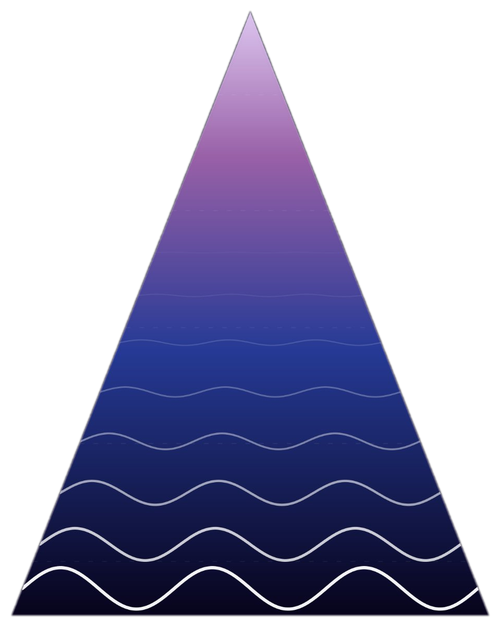
Megaprojects don’t fail because uncertainty is unknowable. One of the most consistent reasons they do fail is that the information about it never reaches the people with authority to act on it. Each organisational layer has its own mechanism for absorbing a signal before it can force a decision — resolve it locally, reframe it as manageable, compress it to a number, filter it before escalation, then defend the number once it’s been approved. The result is a programme that believes it is tracking to plan, up to the moment it demonstrably isn’t. Five failure modes. Five boundaries. One consistent pattern.
The structure
Five layers, one signal
Uncertainty originates at delivery and must reach sponsors and boards before it can be acted on. Between source and decision sit five distinct organisational layers, each with its own relationship to risk — and its own way of modifying what passes through it.
The mechanism
Failure modes, not failure events
Each layer exhibits a specific pattern: sedimentation, normalisation, translation loss, political filtering, false authority. These are not one-off failures. They are structural tendencies, present in some form in almost every major infrastructure programme — each reinforcing the others.
The application
Recognition before remedy
Countermeasures exist for each failure mode. But they only work if the failure mode has been named. The diagnostic view provides a set of observable signals — language patterns, reporting anomalies, behavioural tells — that allow you to identify which modes are active in your own programme.
Ready to begin?
Scroll back to the top and select a view from the navigation bar
Choose from Failure Modes, Cascade Trace, Diagnostic, or Healthy Pathway to start exploring the Signal Decay Pyramid.
The Five Failure Modes
How to use this view
Work through each failure mode in sequence — from L1 to L5
Each failure mode represents a distinct organisational layer through which a risk signal must travel — from the point of origin at site, all the way to the sponsor and board. They are not independent. Each one conditions the next: what sedimentation buries, normalisation cannot correct; what normalisation distorts, the model encodes as fact; what the model encodes, political filtering presents as certainty; and what the board approves becomes the floor that false authority defends. Working through them in order reveals the full decay path — and shows why interventions at a single layer rarely break the pattern.
Signal Decay Pyramid
Why a scenario?
The five failure modes are easier to understand in the abstract — but harder to act on without seeing how they connect in practice. A scenario makes the decay path concrete: you can follow a single risk signal as it moves through each organisational layer and watch precisely where and why it gets absorbed, reframed, or suppressed. Rather than describing failure modes in isolation, this trace shows them operating as a system — each one conditioning what the next layer receives. Use it to test whether the pattern feels familiar.
Scenario: A significant ground conditions risk is first identified by a site team on a critical work package at programme month 6.
Signal Decay Pyramid
Check the signals you can observe in your programme. The risk profile builds as you go — not as a score, but as a prompt to name the pattern. Think about a programme you know well. Where do problems tend to disappear before they reach the next layer? Which risks always seem “being managed”? Does your board ever see a number without a range behind it? Use this as a structured way to surface what you already suspect — and to identify which conversations are most overdue.
Failure mode risk profile
Same Scenario but a Healthy pathway: A significant ground conditions risk is first identified by a site team on a critical work package at programme month 6.
Signal Decay Pyramid
The pattern described here is not exceptional — it is the structural default. These five failure modes are not individual failures of judgement. Each represents a rational local behaviour: managing locally to protect the team, characterising uncertainty optimistically to close the design gate, converting ranges to points because leadership expects precision, filtering technical detail to avoid burdening sponsors, defending the approved number because that is what commitment means in this culture. Five rational actors. One irrational system. The signal doesn’t evaporate through negligence. It evaporates through architecture.
L1 · Sedimentation
Buried at source
Problems resolved locally before the programme sees them.
L2 · Normalisation
Characterised out of existence
Uncertainty described in the most manageable terms available.
L3 · Translation loss
Ranges become points
Precision of the output conceals the uncertainty of its inputs.
L4 · Political filtering
Truth edited before escalation
Boards approve what they are allowed to understand.
L5 · False authority
Approval treated as certainty
The programme defends the approved position rather than updating it.
The way forward
The pattern is persistent — but it is not inevitable.
Each of the five failure modes described here has structural countermeasures. None of them are extraordinary. What they share is a requirement for intentional design: early warning cultures that reward honest escalation; independent characterisation of scope and uncertainty; assumption registers that travel with model outputs; governance formats that present ranges, not just numbers; and approval language that states what it does not resolve. These are not heroic interventions — they are the conditions that allow uncertainty to do its job.
The obstacle is not awareness. Most experienced programme professionals recognise these patterns the moment they are named. The obstacle is that the systemic conditions which produce signal decay are also the conditions that feel normal from inside them. Naming the pattern is the first move. Building the structural response to it is the next.
That is where the work begins — and where the right partner makes the difference.
Working with Kaleido
The gap described in this article is the gap Kaleido was built to close.
We work with leaders and project teams across infrastructure, energy, and defence to bring Decision Intelligence into the way programmes are run. That means helping organisations frame the right problems before committing to answers, build investment cases that are honest about uncertainty, and put the analytical and governance structures in place that allow consequential choices to be made with clarity rather than momentum.
Our work spans strategic advisory, integrated risk and cost modelling, and digital programme controls — not as separate offerings, but as connected capabilities that serve a single purpose: ensuring that the decisions at the heart of a programme are as well-founded as the assets they produce.