
Defence is being asked to move at wartime pace. But the processes, governance and risk frameworks underpinning delivery were designed for a different era. Drawing on DAIC Connect 2026, this blog examines the convergence of procurement reform, adaptive assurance and epistemic risk — and how Decision Intelligence provides the connective tissue between long-term planning and the rapid feedback loops that modern project delivery demands.
What this article covers
A reflection on DAIC Connect 2026, structured around five themes that emerged from the conference:
Theme 1: The Decision Speed Problem
Procurement is stuck in the 80’s. The Strategic Defence Review demands a force that is faster, leaner and AI-enabled by 2035, but current processes cannot keep pace.
Theme 2: The Paradox of AI Disruption
AI creates the very disruption it is needed to resolve. Organisations must build the capability to adapt continuously rather than wait for stability.
Theme 3: Epistemic Risk and What We Are Not Measuring
Most risk frameworks handle variability well but are blind to structural unknowns, the things we do not yet know to look for.
Theme 4: Adaptive Assurance of AI and JSP 936
Assurance must shift from rigid gate-based checks to continuous, adaptive evaluation that evolves alongside the technology it governs.
Theme 5: Long-Term Planning Meets Short-Term Sprints
Strategic direction and rapid iterative cycles must coexist not compete. The failure of waterfall was acknowledged at every level of the room.
Synthesis: Decision Intelligence as the Connecting Thread
How these themes converge around a single challenge and why Decision Intelligence provides the connective tissue.
Earlier this week I attended the Defence AI Centre (DAIC) Connect conference in the City of London. Last year we wrote a conference paper for our clients. This year I came away thinking less about any single technology announcements and more about a shift in language that has serious implications for how we plan, assure and act on complex decisions.
The phrase that stuck with me was the move from situational awareness to situational foresight.
Air Vice Marshal Ola Fashade used it during his opening address. On the surface it sounds like a military concept, and it is. But strip away the battlespace framing and what he is describing is a challenge every defence acquisition, materiel logistics support and major infrastructure delivery faces: the difference between knowing where you are and understanding where you are heading before it is too late to change course.
That distinction sits at the heart of what Kaleido calls Decision Intelligence.
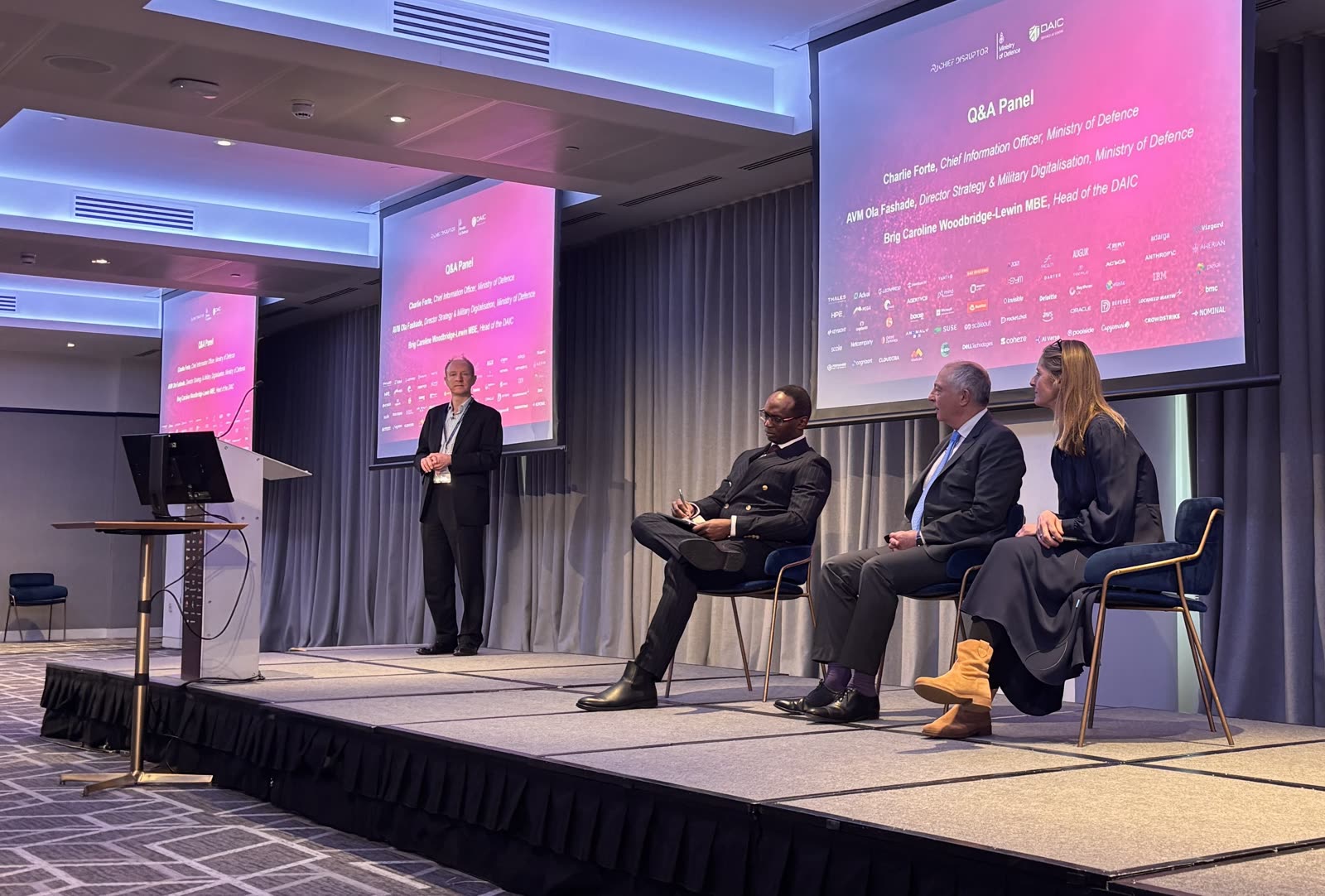
The Q&A panel at DAIC Connect 2026 — Charlie Forte (CIO, MOD), AVM Ola Fashade (Director of Strategy & Military Digitalisation) and Brigadier Caroline Woodbridge-Lewin (Head of DAIC)
Theme One
The Decision Speed Problem
A recurring theme throughout the day was pace, and the Strategic Defence Review (SDR) was the backdrop that gave it weight. The SDR was referenced multiple times across keynotes and panels, and its central vision statement sets the tone: by 2035, UK Defence should be “a leading tech-enabled defence power, with an Integrated Force that deters, fights, and wins through constant innovation at wartime pace.” That phrase — wartime pace — ran through every conversation. It is a policy commitment that reframes how quickly defence organisations, and the industries that support them, are expected to move.
Luke Pollard MP, the Minister for Defence Readiness and Industry, was candid about procurement being unfit for the AI age. He described rules designed for buying a tank in 1987 still shaping processes today, calling them “stupid.” In one example, a procurement specialist had to be contracted simply to complete a form confirming that a platform acquisition did not contain: wood. Although I have equally amusing examples of my own, the common thread is decision-makers held hostage by processes so redundant they exist only because no one has stopped to question them. But even where those processes cannot yet be changed, the answer is not to wait, and that decisions can and should be made in the interim, acting on what is available now rather than what might be perfect later. Organisations that move first with what they have will outperform those still waiting for complete.
70% usable today beats 100% perfect and late. — Air Vice Marshall Ola Fashade, DAIC Connect 2026
Charlie Forte, the MOD’s Chief Information Officer, went further. He used the “faster horses” metaphor — the point being that it is not just about doing the same thing quicker. It is about reimagining capability entirely. He then laid out four priorities:
1 · Act Faster
Using software, data, automation and agentic tools. He was explicit that waterfall does not work anymore and that a fundamentally “different way of planning” is needed. This is not incremental improvement; it is a call to replace sequential processes with approaches that can absorb the pace of change rather than resist it.
2 · Focus on Outcomes
Defence needs a “digital backbone” with continued investment, but he acknowledged that defence struggles with horizontal organisations. Data, tools and teams remain siloed by command, function and platform. The emphasis was on breaking through those boundaries to deliver outcomes rather than outputs. Anyone working in capital projects will recognise the pattern: cost data in one database, schedule in another, risk in a third, with periodic attempts at integration through spreadsheets, slide decks and/or PowerBI to governance boards. Silos are not a project problem. They are a decision problem.
3 · Build New Skills
And critically, not just technical skills. He called for training at leadership and decision-maker level, and for more panel-level experts and so-called SME “hyperscalers” — smaller, specialist companies that can design, build and deliver tools directly into the process. The implication is significant: the people who make decisions need to understand what AI can and cannot do, how to frame the right questions, and how to build the governance frameworks that allow AI to be adopted responsibly and at pace. If leadership cannot engage with this at a strategic level then the decision bottleneck simply moves from these exponential capabilities to the person. The technology is ready, but the decision-making culture around it has not caught up. Something I’ve written before about raising the complexity ceiling.
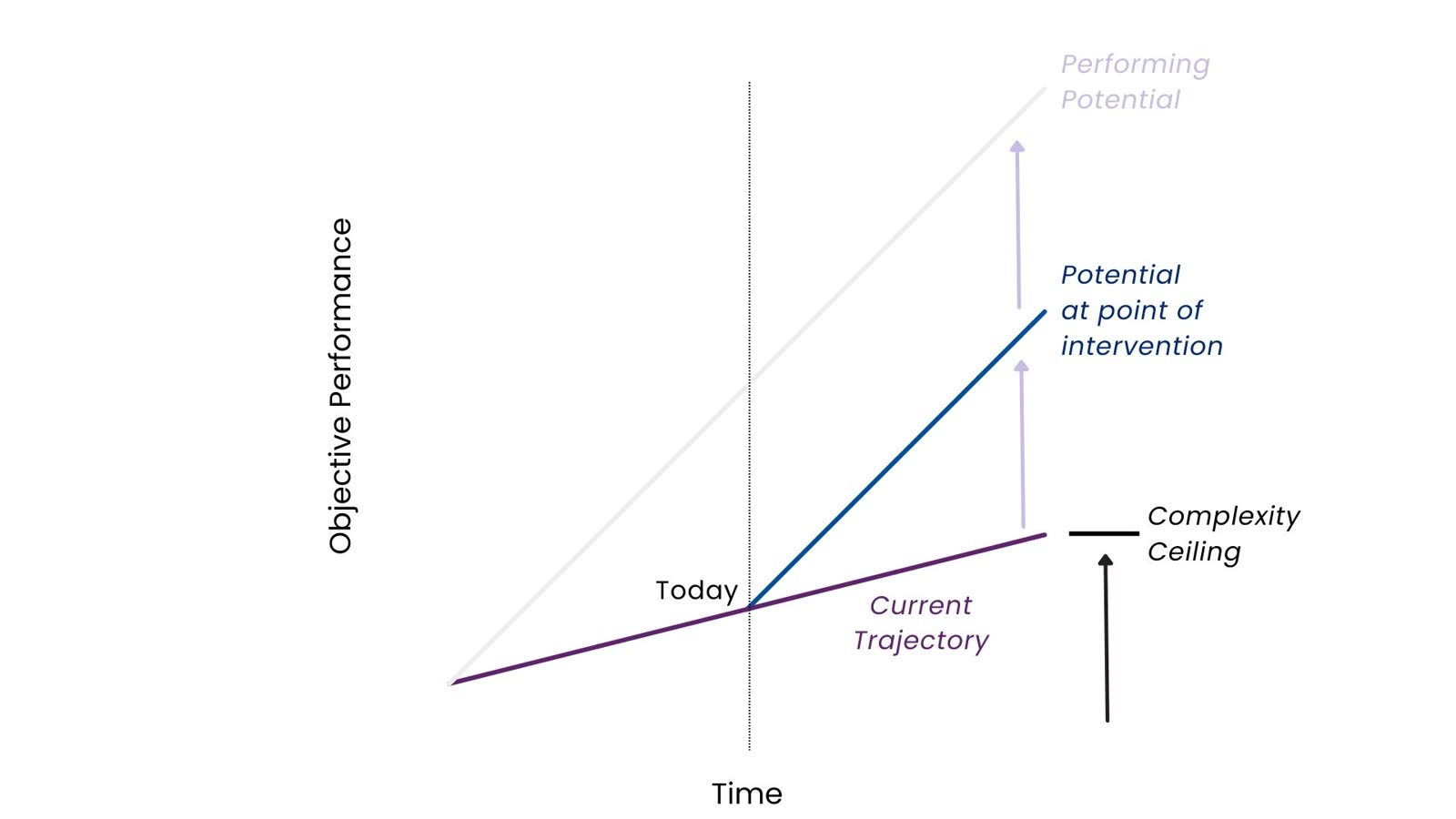
The decision complexity ceiling — where traditional practices are overwhelmed by the volume and interconnectedness of modern project environments, and where performance potential can be unlocked from the outset or at any point of intervention
4 · Don’t Forget the Digital Basics
There is a need for end-to-end systems, and a need to address increasingly compounding obsolescence. Before organisations can benefit from AI, they must have the underlying data infrastructure, integration and governance in place. Without it, advanced capability sits on top of fragile foundations.
Brigadier Caroline Woodbridge-Lewin, Head of DAIC, also noted that the centre is now handling 400 AI products across delivery, availability and business operations, with tens of thousands of users on MODGPT and an AI playbook due for publication later this year.
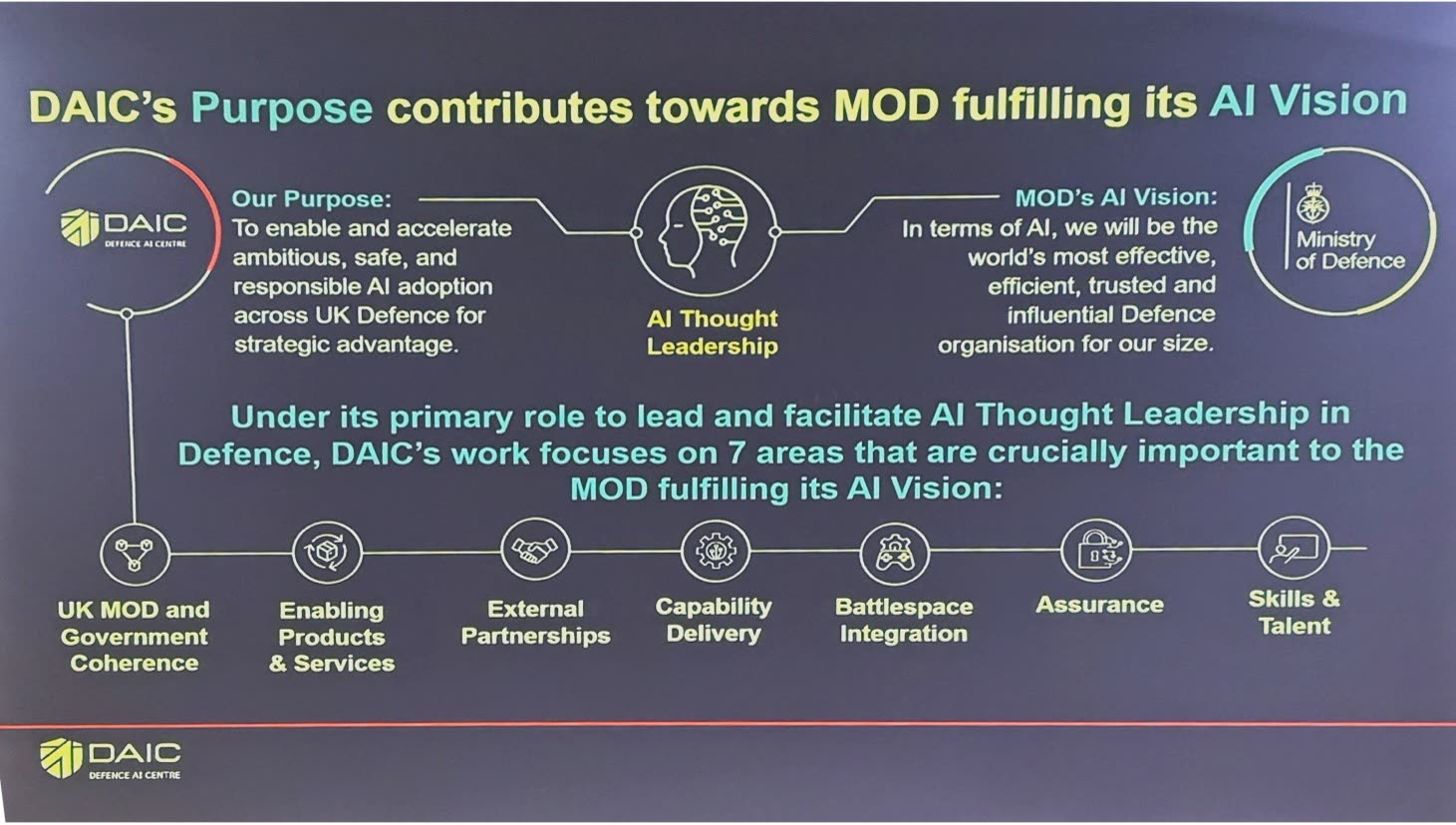
The MOD and DAIC’s AI vision — the strategic framework driving AI adoption across UK Defence
For those of us working in procurement and capital project delivery, this is not a foreign concept. It is a familiar frustration. We can spend months waiting for the P50 number, the fully baselined schedule, and the next ‘completed’ document or artefact, before anyone is willing to make a commitment. The world those projects operate in is changing faster than those processes were designed for.
Theme Two
The Paradox of AI Disruption
Cameron Stanley, from the US Chief Digital and Artificial Intelligence Office, made a point during his fireside chat with AVM Fashade — and I’ve been mulling over it since. He argued that AI creates exponential logistical issues through the disruption of its own adoption. However, he claimed that AI is also the only tool capable of resolving those issues at speed.
It is a paradox, but it highly resonates. In project delivery we see it constantly. Organisations adopt new tools, new platforms, new data systems, and the immediate effect is disruption, such as changed workflows, retraining, integration challenges, resistance. The instinct is to slow down and wait for stability. But the pace of change means stability never arrives. The only way through is to build the capability to decide and adapt continuously, not to wait for the landscape to settle. It is something I’ve been unknowingly navigating for a while: bridging the gaps between teams, translating context across organisational boundaries, and keeping decisions connected to reality.
The reality of complex projects is that they are not static. Scope evolves, risks materialise, assumptions erode, stakeholders change, and the data underpinning every commitment shifts continuously. Yet most project environments still treat analysis as a periodic event, such as a quarterly risk review, an estimate update every few years, critical stage-gate submission information prepared weeks, months, sometimes years, before the board sees it. By the time the analysis reaches the decision-maker, the project has already moved on. The data is stale and the window for action may have closed.
What is needed is a continuous flow: data captured routinely, models updated as conditions change, interdependencies traced in real time, and analysis surfaced to decision-makers when it is still actionable — not when the reporting cycle happens to demand it. This is the kind of work Kaleido does day-to-day: connecting cost, schedule and risk into integrated models that evolve with the project, running scenario analysis that responds to live conditions rather than frozen baselines, and ensuring that the people making the decisions have current, contextualised intelligence rather than retrospective summaries.
Kaleido Observation
Decision Intelligence treats decisions not as isolated moments but as engineered artefacts — ones that can be understood, challenged, revisited and improved as circumstances evolve. Not a single point-in-time commitment, but a living system of reasoning that grows with the project.
Theme Three
Epistemic Risk and What We Are Not Measuring
A valuable and highly relatable contribution for me came from Shefali Sharma, CEO and Co-Founder of Oxford Dynamics, during the Reimagining Modern Warfare panel. She drew a distinction between two fundamentally different types of uncertainty: aleatory and epistemic risk.
Aleatory risk is uncertainty from inherent variability — the randomness that remains even after you have studied your variables thoroughly. Effort, weather, productivity, proximity, and so on. You can model it, build contingency for it, and plan for its spread but you cannot eliminate it. Epistemic risk is different. It is uncertainty that arises from gaps in knowledge, such as incomplete data, weak assumptions, and poorly understood causal relationships. In principle, it is reducible but you could know more than you currently do.
In projects we often reach for Rumsfeld’s grid of knowns and unknowns, that is the idea that ignorance comes in layers. There are things we know we know, things we know we don’t know, things we don’t know we know, and things we don’t know we don’t know. Known unknowns and unknown knowns are mostly epistemic: gaps that can be closed with effort, better data, or simply asking the right people. Unknown unknowns are more uncomfortable. Some will turn out to be epistemic blindness — things that were knowable, but that no one thought to look for. Others, once revealed, will prove to be aleatory and irreducible variability that was always present, just unseen.
Shefali’s argument was that we currently focus almost entirely on what we can model and quantify, the aleatory. But the risks emerging in an AI-driven environment are predominantly epistemic, and in some cases extend further still, into uncertainties we do not yet know to look for. What happens when the model is wrong? When the training data does not reflect the real world? When the decision-maker does not understand what it is they are actually deciding on? The danger is not just that we lack the answers. It is that we have not yet thought to ask the questions and in some cases are actively avoiding doing so.
In the Assurance Panel plenary, this was reinforced from a practical standpoint. Panellists were emphatic that assurance for AI cannot follow the same model as cybersecurity processes — if it does, “it will fail”. Cybersecurity assurance is built around known threat vectors, defined perimeters and binary compliance checks. AI does not work that way. The risks are emergent, contextual and often epistemic in nature: they arise from what the model does not know, what the training data does not represent, and what the human operator does not understand about the system’s limitations. Applying a rigid, checklist-driven assurance model to that kind of uncertainty does not create safety. It creates false confidence, which is worse.
Kaleido Observation
This is precisely the gap that Decision Intelligence is designed to surface. The established frameworks are built to assess variability within known parameters. They are far less equipped for structural uncertainty of this kind. Decision Intelligence addresses this by making the assumptions, evidence, and reasoning behind decisions explicit and traceable. It does not eliminate epistemic uncertainty but makes it visible, and visibility is the precondition for managing it.
Theme Four
Adaptive Assurance of AI and JSP 936
The same Assurance Panel — including Alec Thomas (DAIC AI Assurance Lead), Ajay Chakravarthy (Chief AI Officer, Thales UK and owner of the CORTAIX factory), Dr Duncan Hodges (UK CTO for Emerging Technologies, Leonardo), and Lindsay Chadwick (CEO, Mind Foundry) — went further in describing what assurance should look like instead.
They discussed the Joint Service Publication 936, the Dependable Artificial Intelligence in Defence Directive, which embeds ‘human centricity’ as a core requirement, is being revised later this year. The messaging was clear: assurance for AI must be adaptive, not rigid. It needs to be a continuous process, not a gate to pass through once.
From the use case and evidence case perspective, the panel acknowledged what many in the room already knew, “everybody wants AI now”. There is a mad rush, there are significant blockers, and the landscape is changing so quickly that any framework risks being outdated before it is implemented. But they were also clear that it can be done with partnership between industry, MOD and the assurance community. The pace of change is exponential, and older processes will fail under that pressure. Transformation itself needs to be highly adaptive, something else I have written and spoken about recently.
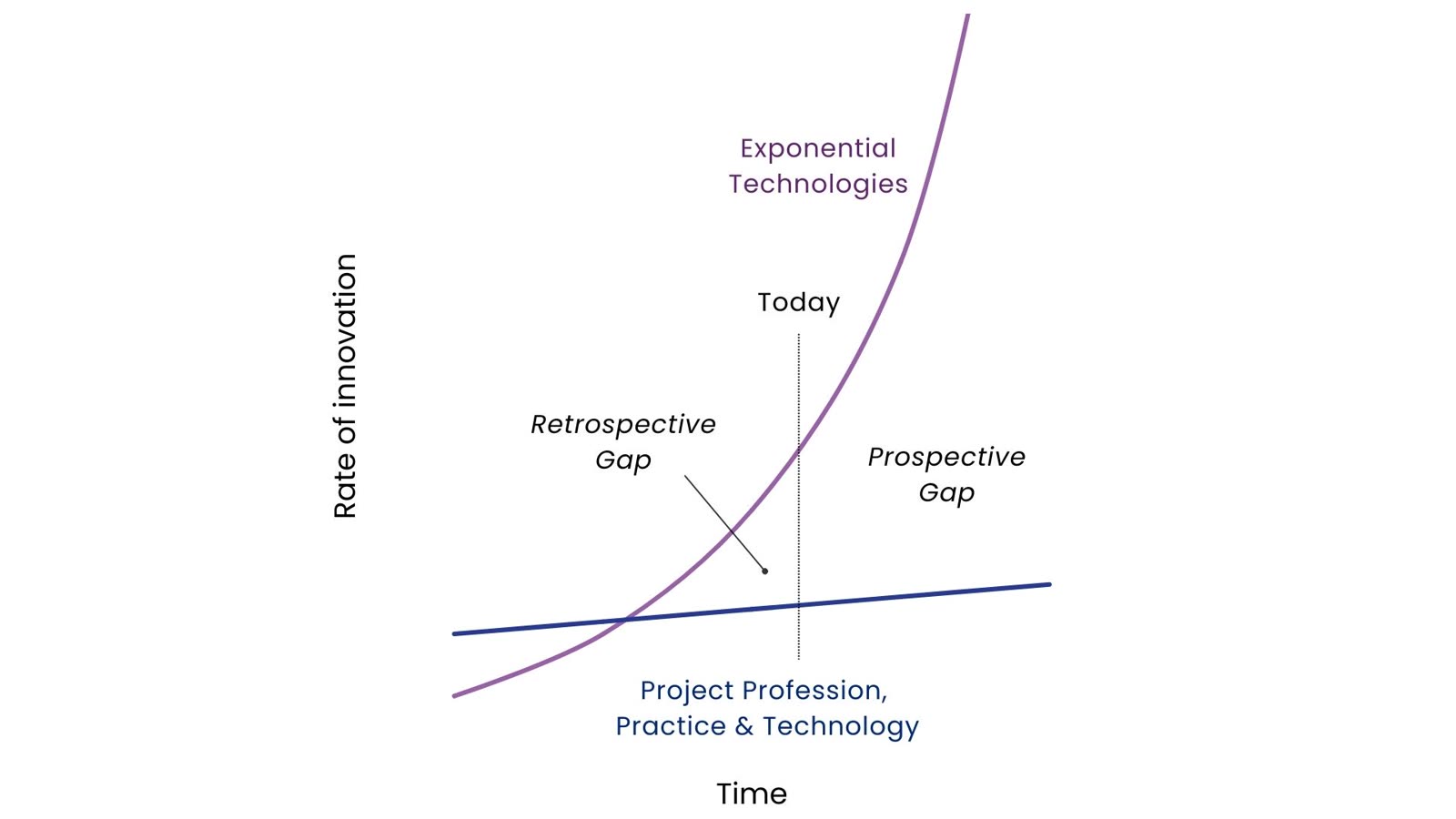
The exponential gap — the widening divide between accelerating technology capabilities and current ways of project delivery
This has direct relevance beyond defence. In capital projects, we face the same tension. Governance structures designed for predictable, sequential delivery cannot absorb the pace at which AI-driven tools and data environments evolve. The answer is not to abandon governance, but to redesign it around continuous evaluation rather than point-in-time sign-off.
Theme Five
Long-Term Planning Meets Short-Term Sprints
By the afternoon, a pattern had emerged across three very different speakers who were all describing the same problem from different vantage points.
In the morning, AVM Fashade framed it as the tempo of decision-making itself: understand, decide and act at machine speed. “We battle in petabytes — that is our new ammunition.” The implication is that the decision cycle must compress, not just the delivery cycle. Charlie Forte gave this operational teeth by declaring waterfall dead and calling for fundamentally different planning approaches — not faster horses, but a different mode entirely.
During the Catalysing a World-Leading Defence AI Ecosystem panel, Blythe Crawford CBE (Director, Tiberius Aerospace) landed the most practical articulation. He discussed how hierarchy stalls procurement and drew a clear distinction between long-term planning and short-term planning for feedback and optimisation. Arguing that the two must coexist, not compete. He called for a shift towards a Silicon Valley style of operating: long-term strategic direction combined with rapid, iterative cycles that test, learn and adapt continuously.
What is striking is that the failure of procurement was acknowledged at every level of the room. At ministerial level, Luke Pollard called the procurement rules “stupid” and that we need to accelerate procurement to “wartime pace”. At operational level, Blythe described hierarchy stalling progress. At industry level, Dr Mark Maybury from Lockheed Martin said systems used for years need to be compressed from years to months, weeks, days, or even hours — and noted that Lockheed Martin now operates 22,000 agents across 40 to 55 LLM suppliers. When a minister, a former Air and Space Warfare Centre commandant, and a Lockheed Martin VP are all saying the same thing, it is not commentary. It is a signal.
Capital projects are typically planned for the long term, not for short-term sprints. But Kaleido has consistently found that the most effective delivery strategies combine both. A long-term strategic architecture with the ability to run agile sprints to trial and test new approaches, providing the feedback loops that allow continuous optimisation, adaptive estimates, and evolving assumptions. This is not about replacing rigorous planning with improvisation. It is about ensuring that plans remain living instruments rather than monuments to assumptions that may no longer hold.
Modern-day warfighters are digital at birth. It’s the technology that is now beyond the human scale. — John Abel, Google Cloud, Defence AI 2030 panel
This is also where the generational dimension matters. John Abel from Google Cloud made the point during the Defence AI 2030 panel that modern-day “warfighters are digital at birth”. It’s the next generation that have grown up with technology, yet the processes and technology around them are aged. This applied to the next generation in project delivery. John went further and said it’s the technology that is now “beyond the human scale”, while we have a generation of professionals who are comfortable with AI, real-time data and iterative ways of working, operating within governance structures designed for a world that moved at a fraction of today’s pace.
Synthesis
Decision Intelligence as the Connecting Thread
What struck me most about DAIC Connect 2026 was not any single announcement but the convergence of themes. Every panel, every keynote, every corridor conversation pointed in the same direction:
- Decisions need to be faster, but not less rigorous.
- Assurance needs to be adaptive, not static.
- Risk frameworks need to account for what we do not know, not just what we can measure.
- Technology must serve decision-makers, not overwhelm them.
- Planning must combine long-term architecture with short-term feedback.
- Silos must be broken — across commands, across functions, across data systems.
During the closing panel led by Dr Tim Sheldon (Chief Delivery Officer, DSTL), Air Vice Marshal Mark Ridgway (Assistant Chief of the Defence Staff, Futures & Force Design) presented a three-layer prism that captures the sequencing well: what could AI do for us? What should it do? What would it do? The distinction matters. Possibility without intent is just noise. Intent without commitment is just strategic theatre. It’s this discipline that moves organisations from could through should to would — grounding ambition in evidence and governed action.
Could Possibility Largely answered
Should Intent The hard conversation
Would Commitment Where the gap is
These are not warfighting or defence-specific problems. They are the defining challenges of complex project delivery in every sector. And they are precisely the challenges that Decision Intelligence, as a discipline, is designed to address.
At Kaleido, we bridge the gap between decision-makers and the people, processes, data and technology they need to navigate uncertainty and deliver complex projects successfully. We treat decisions as engineered artefacts rather than ephemeral moments, ensuring that the reasoning, evidence and assumptions behind every critical choice are explicit, traceable and continuously improvable.
The conference reinforced what we see daily in our work: the organisations that will thrive are those closing the capability gap, raising their complexity ceiling, and enhancing situational foresight — prioritising data readiness over the maturity of documentation and looking towards outcomes than retrospective reporting.
That is what Decision Intelligence enables. And that is what we do.

Volunteers in civil war-era armour at the DAIC Connect Dinner & Defence AI Awards at the Honourable Artillery Company Museum - a reminder that methods that worked well once, belong in one
The evening closed with the DAIC Connect Dinner and Defence AI Awards. Volunteers greeted guests in full civil war-era armour — a fitting image to end on. The tools of warfare have changed beyond recognition since the 17th century, but the principle has not: be prepared before the fight, not during it. Whether the battlefield is kinetic or digital, whether the decisions are on the frontline or in the boardroom of a major programme, the organisations that invest in readiness — in their people, their processes, their data and their decision-making architecture — will be the ones that prevail.
#DecisionIntelligence #Defence #AI #ProjectDelivery #DAIC #Kaleido #CapitalProjects #RiskManagement #DigitalTransformation