
The data exists and the decisions are critical. The gap is the quality of the narrative built around that data and the ability to navigate it. It’s the difference between an informed decision and a potentially catastrophic one.
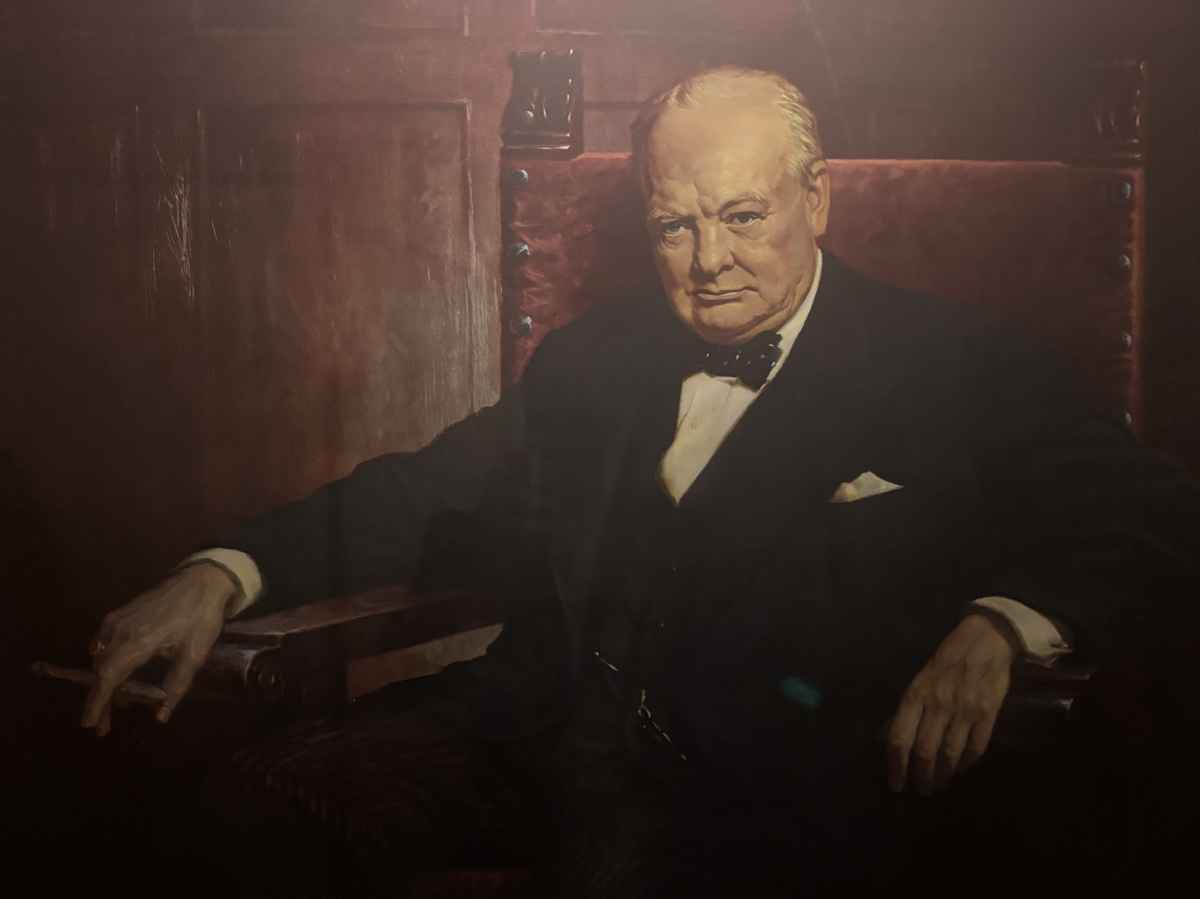
“Hasty work and premature decisions may lead to penalties out of all proportion to the issues immediately involved.” — Winston Churchill
Decision Summit is SharpCloud’s flagship event and this was its first under the Lumivero banner following the acquisition earlier this year. It brought together practitioners from Government, Defence and Industry to share how they are using connected data to tell stories and make better decisions. Hosted at the Churchill War Rooms in London, the setting was not incidental.
Kaleido attended as a strategic SharpCloud partner, and I left thinking about a shift in framing that has been quietly building across the projects we work on. The question is whether the story you build from that data is good enough to act on. And above all, whether project teams have the discipline to sustain it when the picture becomes uncomfortable.
That is what Charles Weston, Head of Enterprise Planning and Risk at the MoD’s Defence Nuclear Enterprise, called “creating, landing, and sustaining the narrative.” It is the most precise description I have heard of what decision-making demands in complex programme environments. And it ran, implicitly, throughout the day.
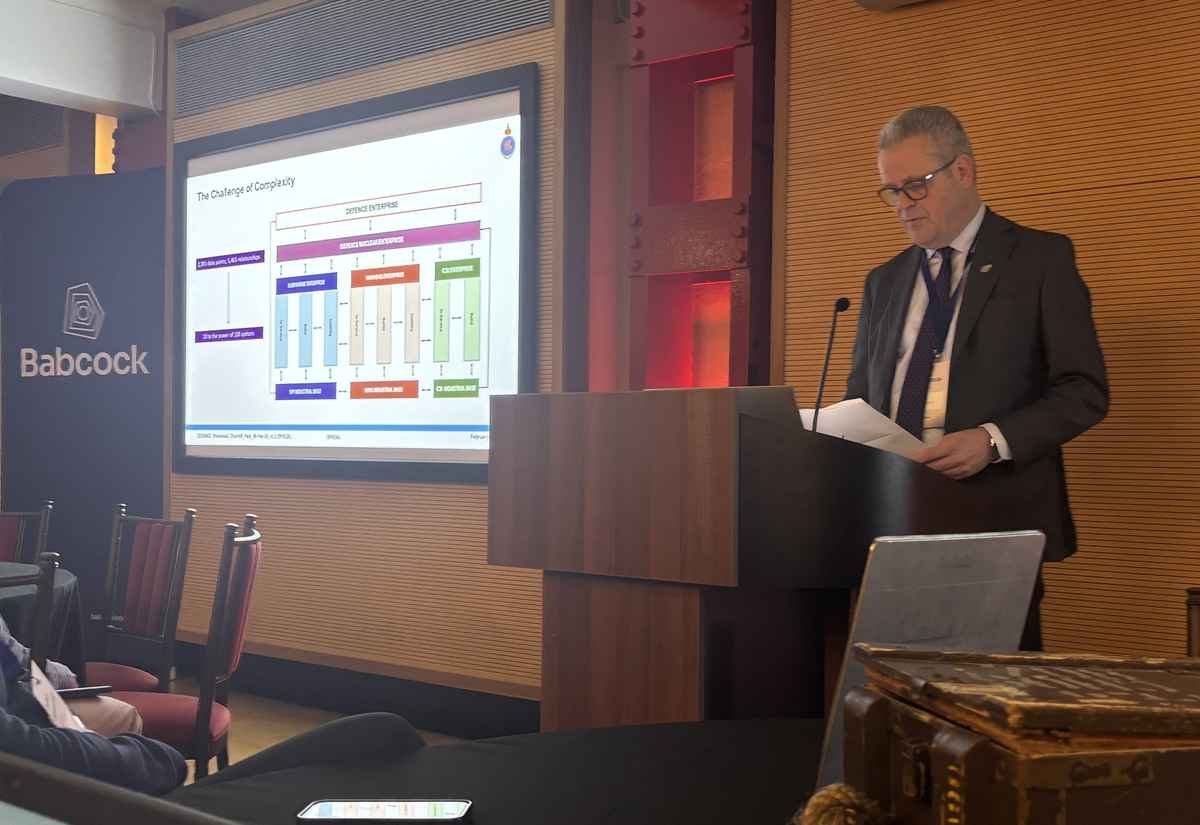
Charles Weston, Head of Enterprise Planning and Risk, MoD — presenting the DNE challenge at the Churchill War Rooms.
Charles Weston’s session opened with a number that sat with me: 10 to the power of 100. It’s the order of magnitude of possible scheduling options across the Defence Nuclear Enterprise’s portfolio. It’s a figure designed to explain why conventional decision-making approaches fail. Not because the people using them are inadequate, but because the problem is structurally beyond the reach of any approach that requires human beings to evaluate options sequentially.
The DNE operates on a planning horizon of over 30 years and next-generation platforms take a decade or more to bring into service. Subject Matter Expertise is siloed, with no general practitioner holding an enterprise-wide view. And without understanding the relationships and dependencies across that system of systems, what you face is not a cascade of risk, but as Charles put it, a tsunami.
The usual objection to connected data environments is that the data is not clean enough — an often-repeated phrase in risk modelling is garbage in, garbage out — and it came up during Q&A. Charles turned this on its head: get the data in regardless of quality. The story it tells acts as the assurance mechanism. Bad data, once visible at enterprise level, drives the teams responsible for it to correct and mature their datasets. I have experienced this myself — the controls loop and the value of iterations when presenting data that hasn’t been integrated before, especially for strategic decisions. All sorts of points can be made that may cause surprise, even to the artefact developer, after going through verification processes such as DCMA-14 health checks. Sometimes it’s only when it is up on the screen and narrated that it can be understood and decided on rationally. The trick is to do this before it’s too late.
This is a recognition that waiting for perfect data before building a decision environment is itself a decision. This data maturity loop only activates when it’s visible. You cannot improve what you cannot see.
Kaleido Observation
This is the argument at the heart of our readiness framework, presented at AACE Annual ConEx 2025 and demonstrated again this year through using SharpCloud to tell the story. The framework is designed to make gaps visible before capital commitment, so that the assurance loop Charles described operates as a leading indicator rather than a post-mortem.
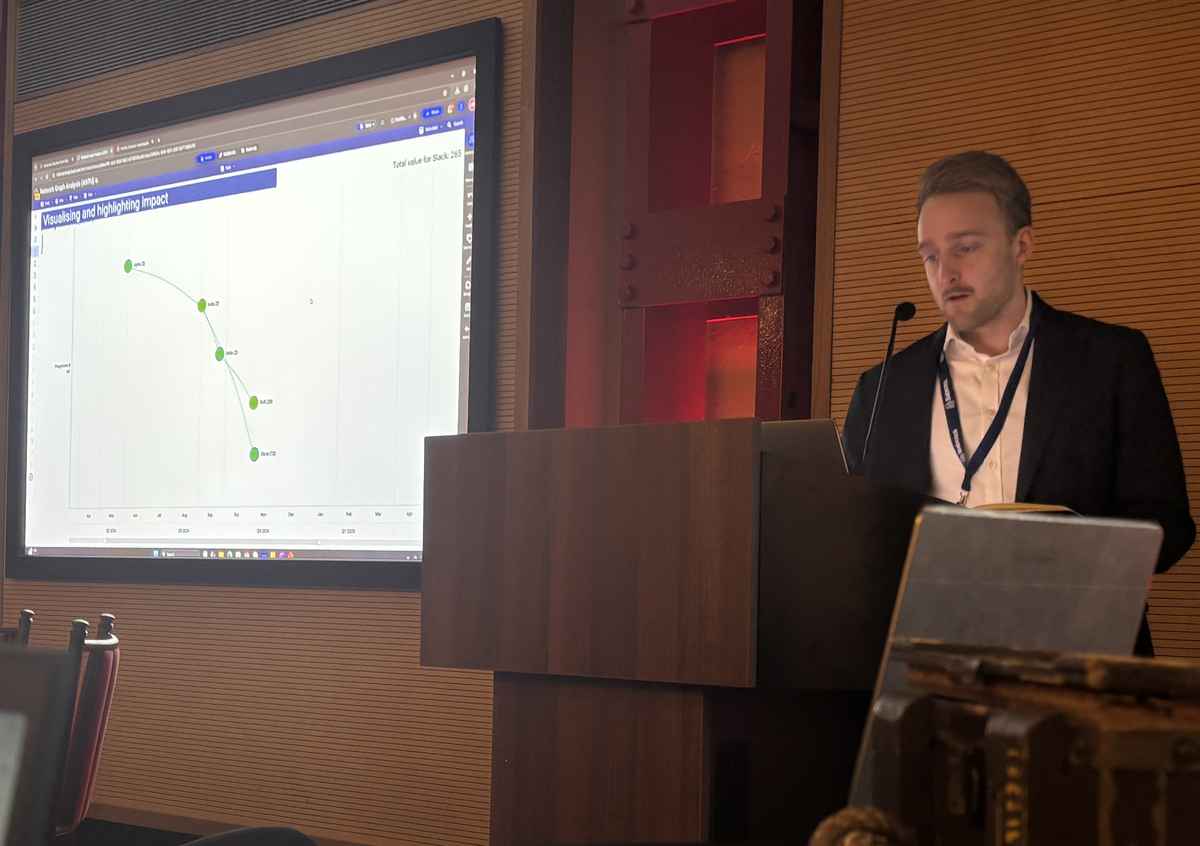
Jonny Morris, Solutions Engineer at Lumivero, demonstrating the Slack visualisation — understanding which milestones can be accelerated or delayed without cascading impact.
If Theme One was about the scale of the problem, Theme Two was about one of the most elegant responses to it I have seen demonstrated in a live environment.
Slack — the risk-adjusted float of programmes within a portfolio — is the amount of time a programme can slip before it significantly impacts its successors or predecessors. In a simple project, this is manageable by eye. Across a programme with 1,093 data points and 5,465 relationships, it is invisible without the right tooling. The Slack story demonstrated in SharpCloud made it visible using a network view showing, for every node, exactly how much movement the system could absorb before propagating disruption downstream.
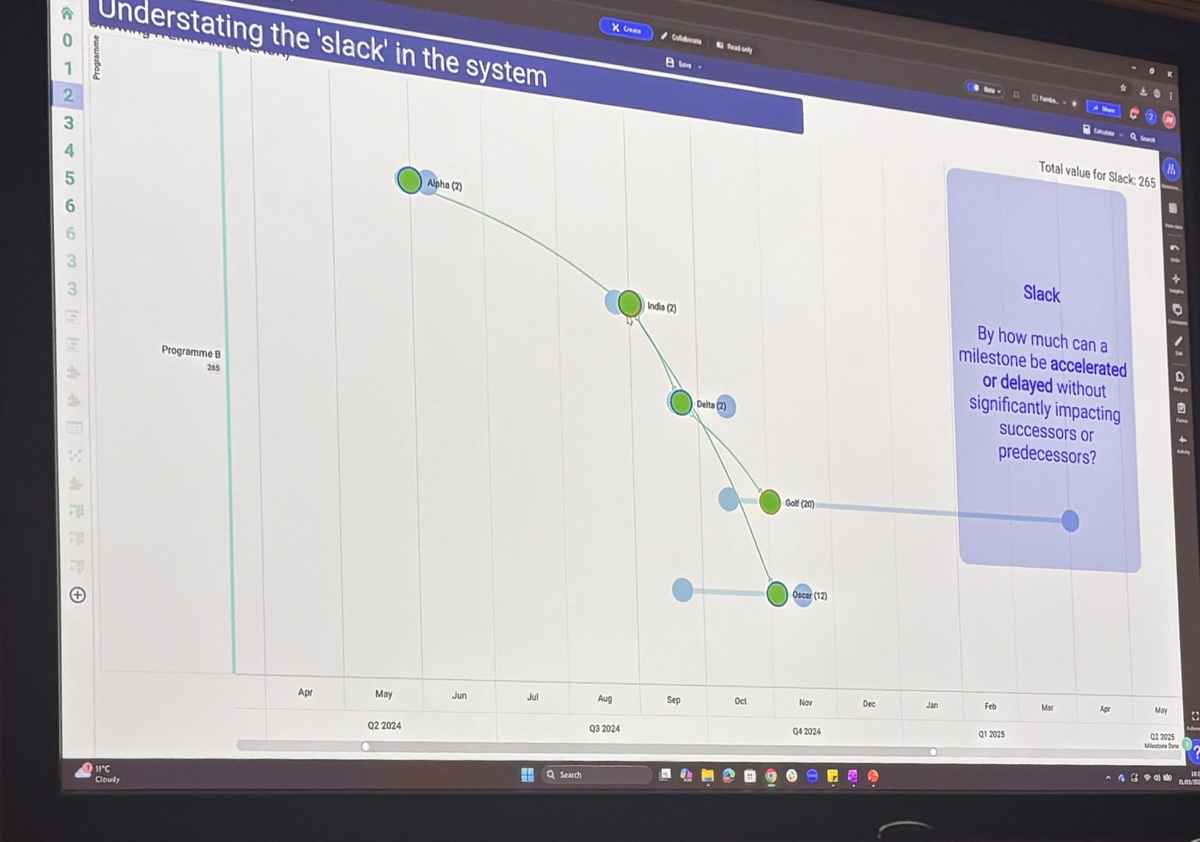
Single programme — how much can each milestone move without cascading impact?
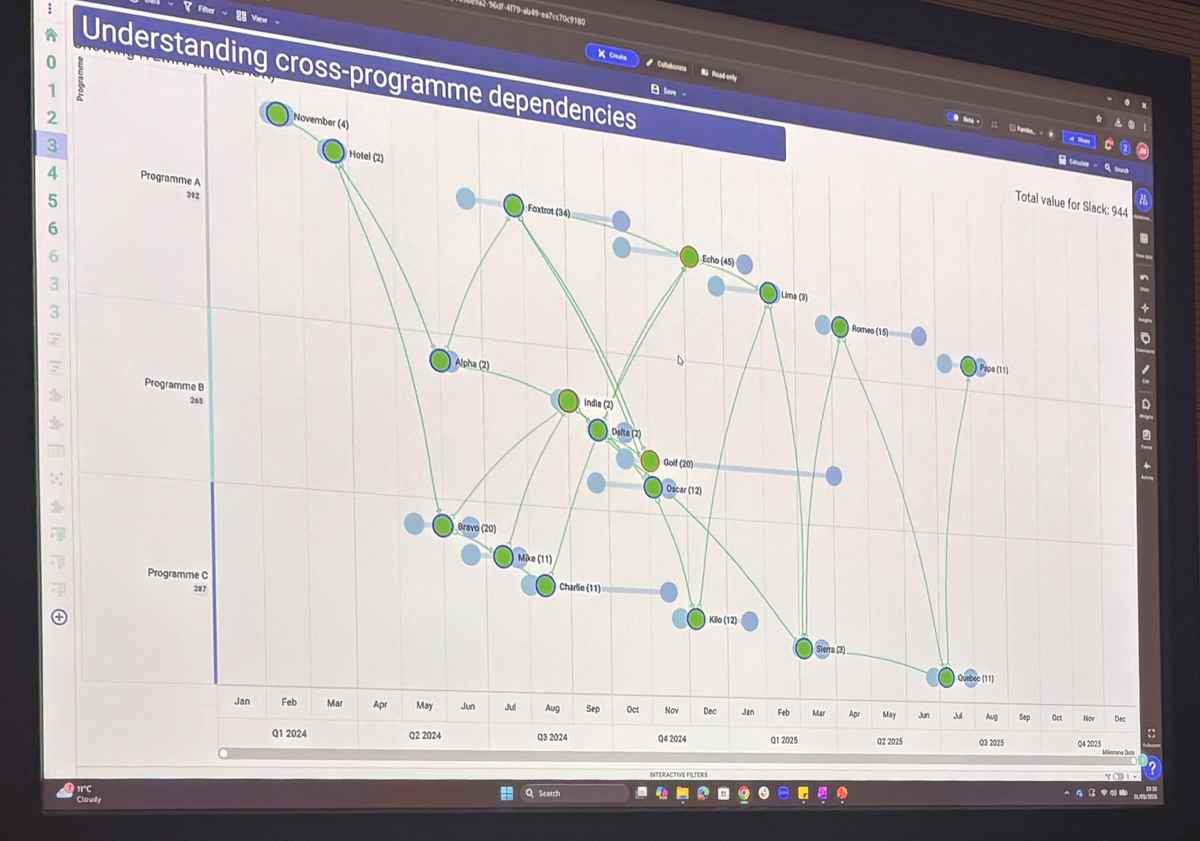
Cross-programme — dependencies and float across Programmes A, B and C simultaneously.
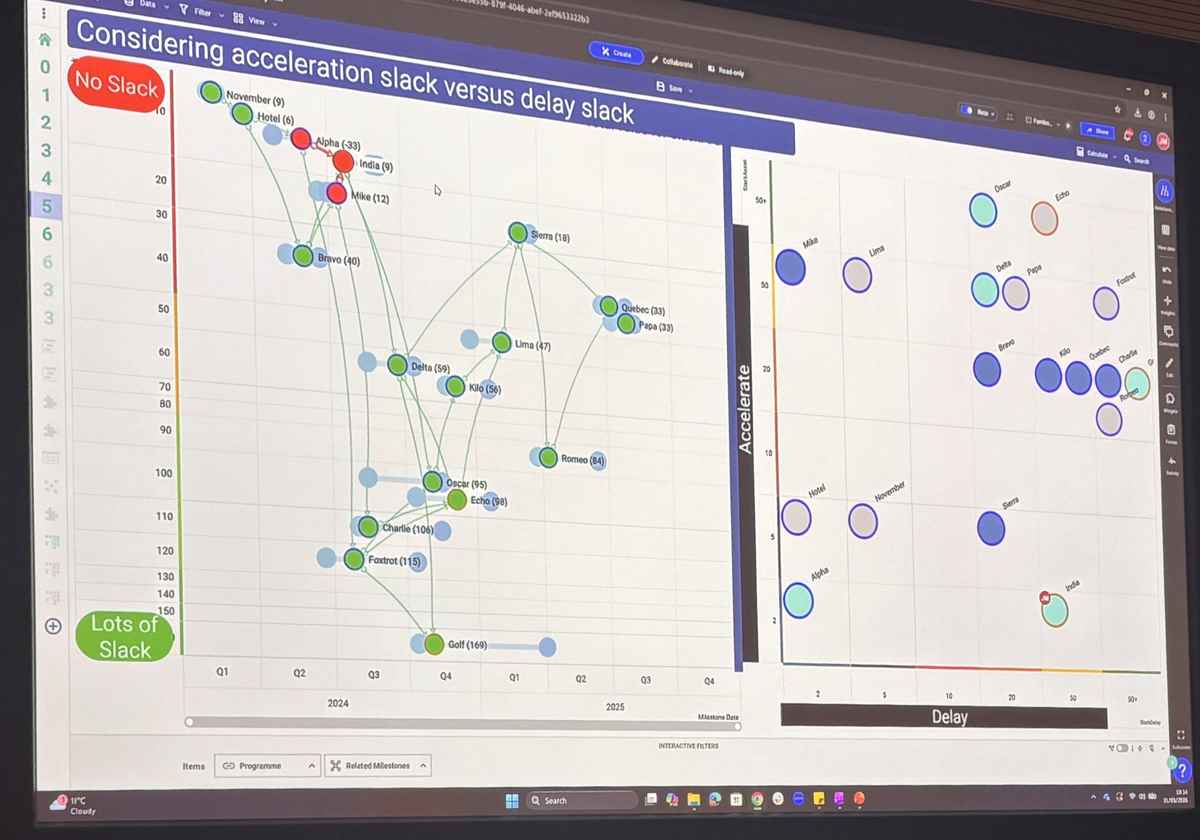
Acceleration vs delay — which milestones have room to pull forward, and which are locked.
The Slack story progresses from single programme float, to cross-programme dependency mapping, to an acceleration/delay matrix that shows precisely where the system has room to breathe.
This matters because the instinct in complex programmes is to manage float conservatively and treat all schedule pressure as equivalent. Slack analysis breaks that assumption. It tells you which milestones are genuinely critical to the system and which have room to move. That distinction is the difference between reactive firefighting and deliberate, sequenced intervention.
Optimise — developed as a bolt-on to SharpCloud, with discovery work commissioned by Charles Weston — takes Slack analysis a step further. Originally derived from an aerospace technique for rerouting flight paths, Optimise uses an ML-driven optimisation algorithm to resequence resource-critical programmes with the goal of maximising a defined outcome: availability, throughput, FTE utilisation, or any other measurable objective. Think of it as critical chain scheduling, but applied to resource constraints across a portfolio rather than tasks within a project.
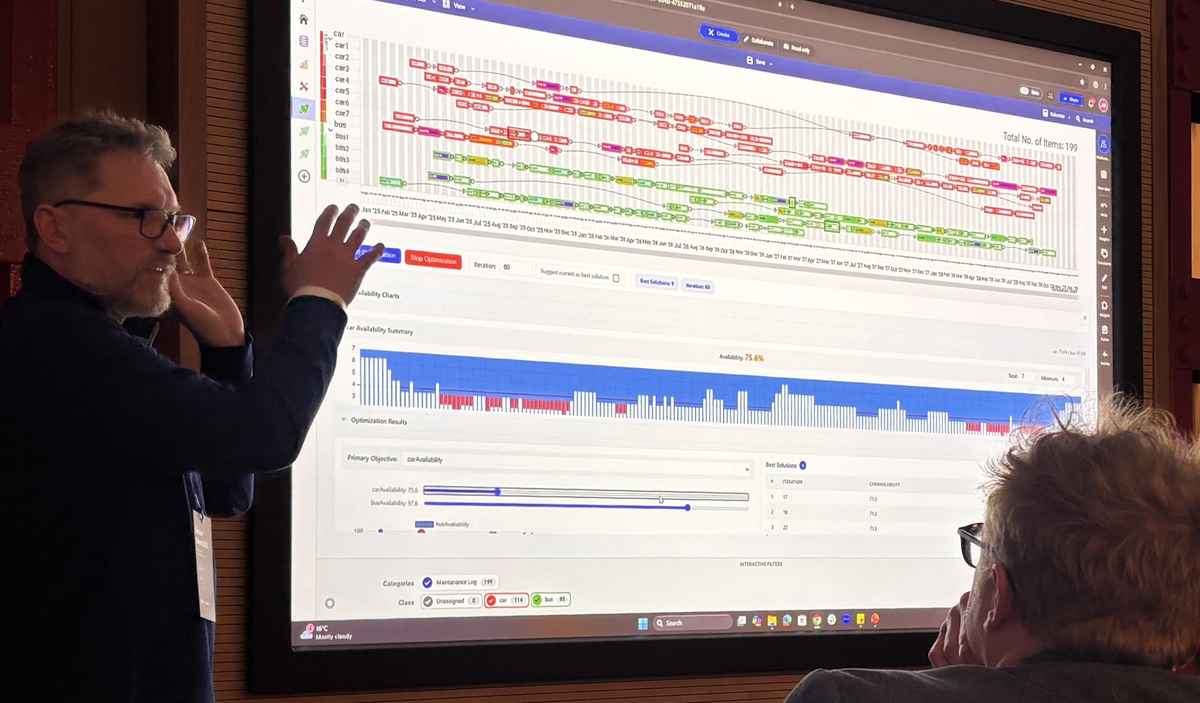
The Optimise application — automating the prioritisation of resource-constrained activities to maximise a defined outcome. Demonstrated using a vehicle maintenance programme.
The declassified vehicle maintenance example used availability as the primary objective. The idea that you could define “maximise platform availability” as a target and let the system propose a resequenced delivery schedule — informed by risk-adjusted confidence distributions from Schedule Risk Analysis — represents a meaningful shift in how programme management thinks about itself. Defence acquisition programmes are not accustomed to being framed as optimisation problems with a calculable objective function. Perhaps they should be.
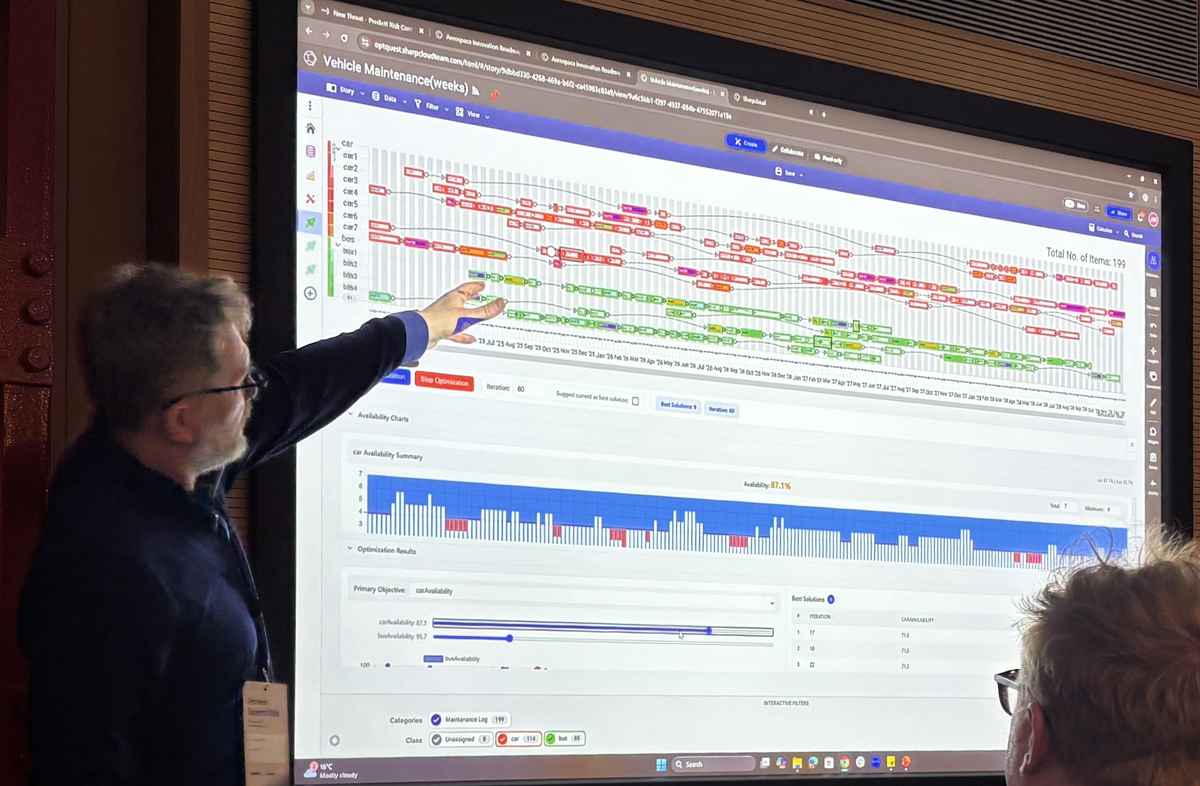
Optimise in action — the availability summary and optimisation results panel, showing the before-and-after impact of automated activity resequencing.
Kaleido Observation
Slack profiling and resource-constrained resequencing are well-established in integrated project controls. What is new is seeing them operationalised at programme scale, in a connected visual environment, with an optimisation algorithm driving the sequencing logic. This is the bridge between Kaleido’s integrated cost and schedule risk analysis offer and SharpCloud’s visualisation layer. The DNE’s willingness to commission and fund this work suggests unmet demand across the sector.
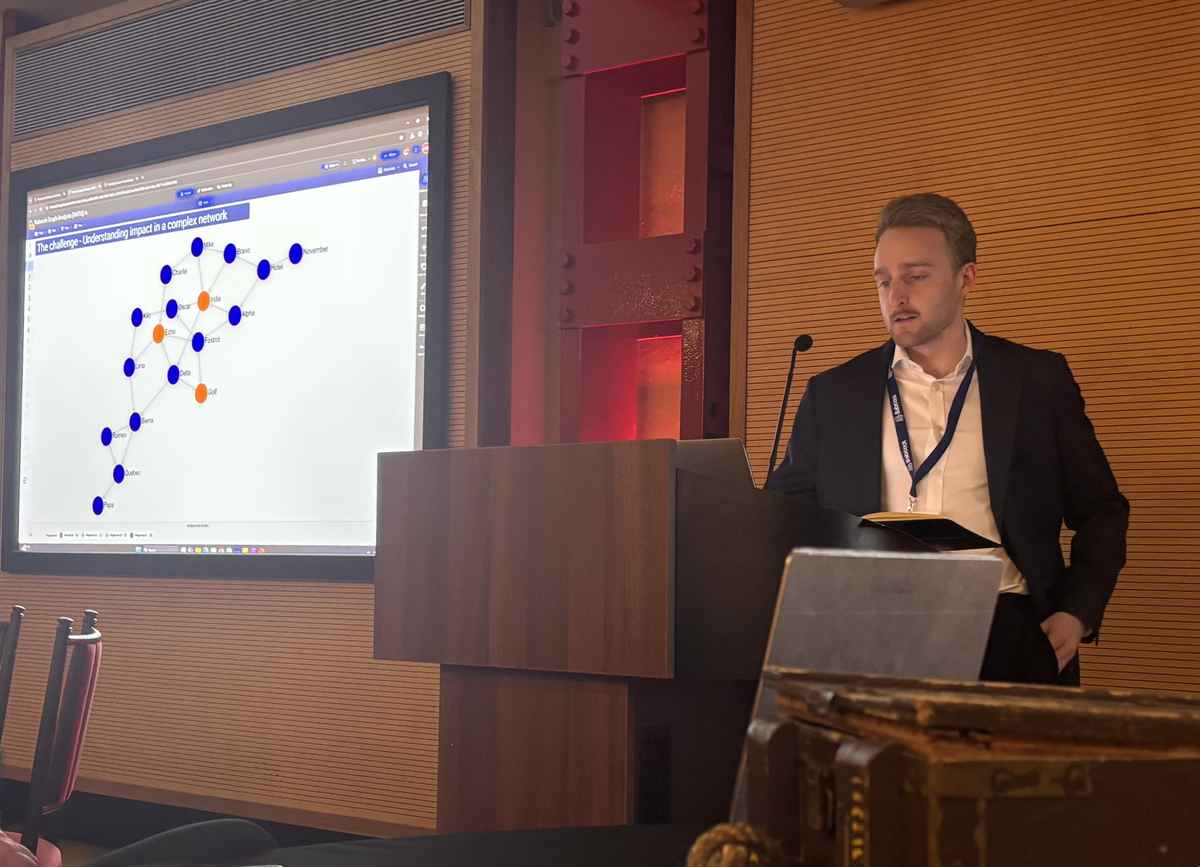
Jonny Morris walking through the programme boundary and network dependency view — understanding which data points exert the most influence across a complex system.
Charles Weston’s phrase, “creating, landing, and sustaining the narrative”, is worth staying with, because it is doing more work than it appears to.
Creating is the analytical problem. How do you build a story from 1,093 data points across a 30-year programme portfolio that is coherent enough for a senior decision-maker to act on? It requires not just data, but the right connective tissue, that is the relationships, the dependencies, and the cascading consequences that make individual data points meaningful in context.
Landing is the communication problem. Data that causes shock and defensive reactions from senior leaders has not landed, it’s collided. Charles noted the temptation to “shoot the messenger” when the story is bad, a predictable response when data has no narrative frame. Landing the narrative means presenting the picture honestly while giving decision-makers a path forward rather than a verdict.
Sustaining is the governance problem. A narrative created once and left static is not a governance tool. It is a project artefact that ends up as shelfware. Sustaining the narrative means building the organisational discipline to update it continuously, challenge it when assumptions change, and return to it when decisions need to be revisited.
Sarim Khan, Head of Enterprise Solutions at Lumivero, made the same point through his five-problem framing:
- 01 data lives in silos
- 02 data is unstructured and inconsistent
- 03 there is no visibility of downstream and cross-programme risk impact
- 04 risk perspective is too narrow
- 05 disconnected systems are informing executive decisions
This is not a product pitch, but a diagnostic of the conditions that make it impossible to create, let alone land or sustain, a coherent narrative. SharpCloud addresses the platform, but it’s the methodology that makes it work.
Jon Gregory’s Rolls-Royce session demonstrated what sustaining the narrative looks like in practice. A governance model where SharpCloud menus are arranged to follow meeting agendas, so that the data environment is the governance structure rather than a report produced for it, is the most mature application of this idea I have seen outside of the programmes Kaleido works on directly.
Kaleido Observation
The narrative is a governance function, not a communications one. When Charles described his six-step process — map, understand, intervene, shape, deliver, sustain — he was describing a decision architecture. This is what Kaleido means by treating decisions as engineered artefacts: structures that can be understood, challenged, revisited, and improved as circumstances evolve. SharpCloud is the medium. The methodology — the discipline of building, testing, and maintaining the narrative — is what gives it teeth.
Jon Gregory, Chief of Technology at Rolls-Royce Defence, gave the most technically detailed session of the day, and one of the most honest.
His starting point was the problem: 950 individual Research & Technology (R&T) projects, 180 columns of data per project, route-maps drawn by hand in PowerPoint, and an Excel spreadsheet sitting at the centre of a governance process that was creaking under its own weight. The move to SharpCloud replaced that with a connected entity model, from the product strategy feeding into capability gap assessments to R&T budget connecting to external funding, and technology taxonomy linking to project proposals and route-maps. All governed through a single environment with dynamic views, relationship mapping, and portfolio-level analytics.
What made the session valuable was not the architecture. It was the candour about what had not yet been solved. Jon’s future aspirations list is a precise statement of where the capability gap currently sits. These included actual cost data from SAP, cost-prediction tools, burn-down charts per product attribute, horizon-scanning integration, natural-language query generation, and crucially, a server accredited for UK Official Sensitive data to bring classified programme intelligence into the same environment.
He also named the cultural barrier directly: “still a tendency to polish before sharing.” This resonated with me, and connects to an earlier point in this article. In my own work in estimating and planning for public infrastructure, the pattern is familiar: artefacts delayed, then underwhelming on arrival. Those who work with me know I am always seeking ways to implement adaptive estimating and risk modelling into the workflow rather than what I call the ‘pass-the-baton relay’, only to often find that inputs, once polished, are not fit for purpose.
It is an organisational behaviour problem: the instinct to present conclusions rather than working data. And it is the same instinct that undermines the data maturity loop Charles Weston advocated in the morning session.
Kaleido Observation
Jon’s aspirations list is a precise statement of the capability gap — and every item on it maps directly onto Kaleido’s offer. This is Decision Intelligence in its PPDT form: People building the discipline to share working data; Process frameworks connecting R&T governance to product strategy; Data structured and classification-ready; and Technology — SharpCloud as the decision environment, with Kaleido’s integrated modelling and GenAI making it actionable. The cultural problem is the hardest part. The approach is the same one that works elsewhere: build the narrative first, and let the visibility drive the behaviour change.
Peter Stokes, Neurodiversity and Social Mobility Manager at Babcock, and Jack Churchill, Co-Founder of Empowering Tech, took the afternoon in a different direction.
There was something fitting about hearing a Churchill make the case for accessible intelligence in the very rooms where another Churchill once acted on it. Jack Churchill — Winston’s great-grandson — argued that visual, connected data environments are not just more effective. They are more equitable. For neurodivergent professionals, the cognitive load of navigating fragmented, text-heavy, spreadsheet-dominated information environments is a material barrier to contribution. SharpCloud reduces that load. It externalises complexity in a form that more people can actually engage with.
This is a decision intelligence point, not just an inclusion point. If the quality of decisions depends on the breadth of intelligence that feeds them, then a decision environment that excludes or exhausts a significant proportion of its users is producing worse decisions. Accessibility is not a charitable consideration. It is a design requirement for any system that claims to support good decision-making.
Kaleido Observation
The best decision environments are ones more people can actually use. This is a principle worth building into how we design and deploy SharpCloud frameworks, not as an afterthought, but as a quality criterion.
Synthesis
Narrate. Navigate. Decide. Decision Intelligence as the Connecting Thread
What struck me most about Decision Summit 2026 was the consistency of the underlying problem across every session, and the consistency of the gap that remains.
Every speaker described a version of the same challenge: data exists and the machinery for connecting the two, whether there or not, still demands narrative.
At Kaleido, we describe this as the decision complexity ceiling: the point at which traditional decision-making practices are overwhelmed by the volume and interconnectedness of the information they are expected to process. It is not a failure of effort or intelligence. It is a structural condition of modern programme delivery, and it will not be resolved by better spreadsheets or more frequent reporting cycles.
What resolves it is Decision Intelligence: a discipline that treats decisions not as isolated moments of judgement, but as engineered artefacts: structures built from people, process, data, and technology working in concert, designed to be understood, challenged, and continuously improved as conditions change. I was speaking with a delegate and we described it as a five-piece band where you have only hired the drummer. It is not a band until they are all playing, and even then, harmony takes another layer of work entirely.
Narrate. Build the story from the data
Navigate. Find the path through complexity
Decide. Act with clarity and confidence
This all points in the same direction. The organisations that will navigate the complexity of the next decade, across defence, nuclear, and infrastructure, are those that invest in the narrative before they need it. That build the decision environment as part of the programme, not as a retrospective reporting layer on top of it. That treat data maturity and readiness as a continuous discipline, not a precondition for action.
Narrate. Navigate. Decide. In that order, as a continuous cycle that gets tighter and more reliable with each iteration.
Decision Intelligence is what closes the loop between data and action. It is the discipline of building narratives robust enough to navigate by, and the courage to act on what they show.
The Churchill War Rooms, London — where Decision Summit 2026 was hosted.
The venue was a reminder that the problem we were discussing is not new.
In the rooms beneath Whitehall, during the most consequential years of the last century, decisions were made under conditions of radical uncertainty, with incomplete data, against the clock, and with consequences that could not be undone. The maps on the walls, the telephone lines running to the surface, the briefings that shaped the direction of entire campaigns. These were the decision infrastructure of their moment.
What made that infrastructure effective was not that it was perfect. It was that it was sustained. The narrative of the war, where the forces were, the options were weighed, and the risks were known, was built and challenged continuously, and acted upon in full knowledge of its limitations. They built the best possible picture, committed to it honestly, and adapted as the picture changed.
Whilst the world has changed, the fundamental discipline of narrate, navigate, decide is the same one that operated in those rooms eighty years ago.
We are still learning how to do it well.
The discipline is not waiting indefinitely. It is building the intelligence to know when you have enough to act, and the narrative robust enough to carry the decision when you do.
“There is, therefore, wisdom in reserving one’s decisions as long as possible and until all the facts and forces that will be potent at the moment are revealed.”
Winston Churchill
Kaleido attended Decision Summit 2026 as a strategic SharpCloud partner of Lumivero. We work with Government, Defence, and Infrastructure clients to bridge the gap between decision-makers and the people, processes, data, and technology they need to navigate complexity and deliver major programmes successfully. If any of the themes raised here connect with challenges you are working through, we would welcome a conversation.